Learning Where I Can Be Fully Me & The Subtle Art of Holding Back
On safety, discernment, and softening the need to self-edit

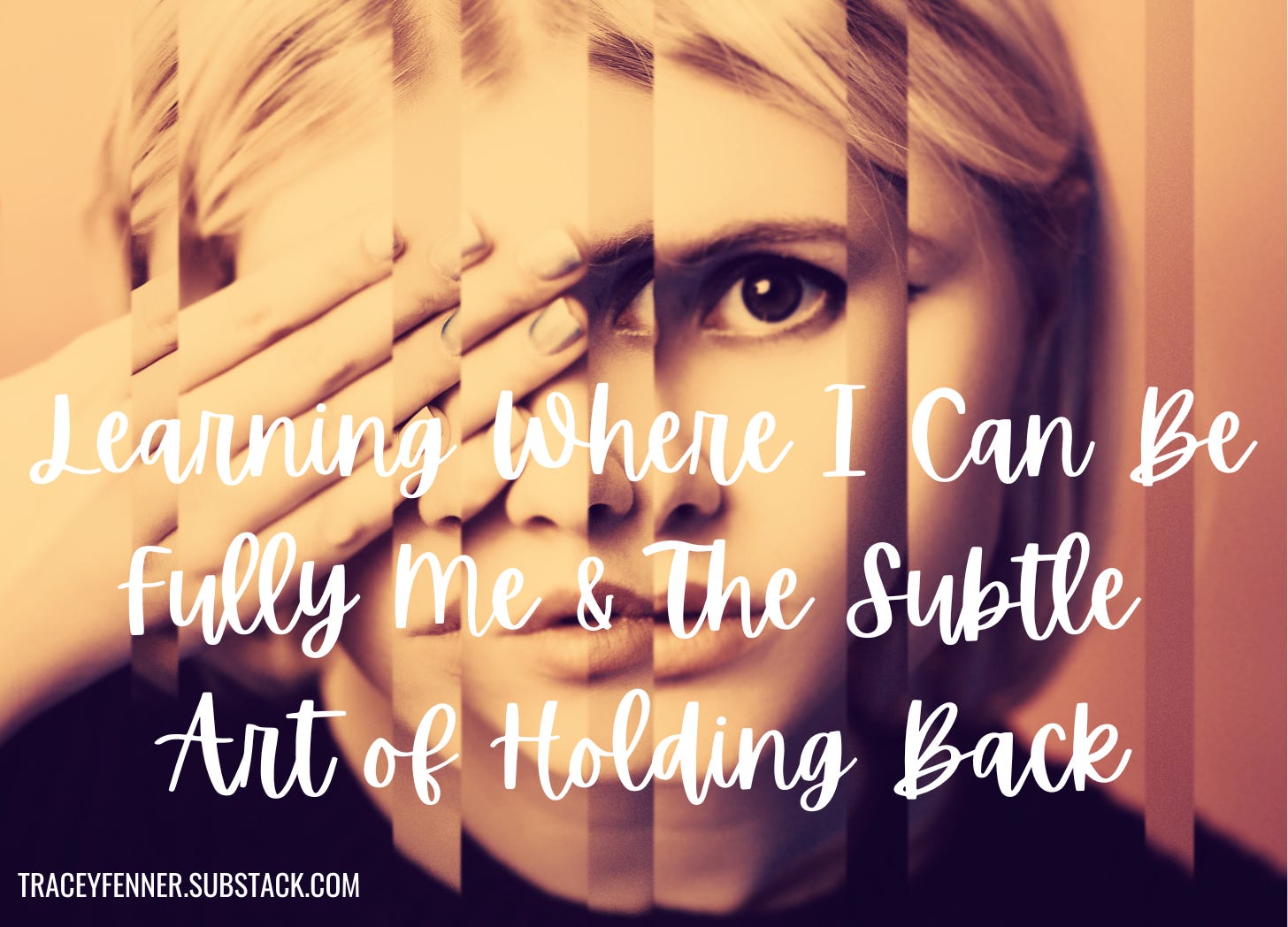
Why I Hold Back (and why you might too) - There are rooms where I arrive as myself. Open. Warm. Unfiltered. Words flowing easily, laughter rising without effort, a quiet sense of this is me settling into my body, and then there are rooms where I don’t.
Nothing dramatic, no obvious alarm bells but something in me gently pulls back. My shoulders draw in, my words become more considered and I listen more than I speak. I choose carefully, what to share, what to hold, what version of me feels most appropriate here. It’s subtle, refined, but it’s there.
And if I’m really honest, I’ve spent years wondering:
Why do I do this?
Because I know I’m not alone in it.
The quiet art of self-protection I used to think this meant I wasn’t being fully myself, that I was somehow. . . dimming myself and holding back.
Perhaps not quite brave enough to just say the thing, be the thing, show the thing, but I see it differently now.
This isn’t weakness, instead I believe it’s intelligence.
Somewhere along the way (through moments we may not even consciously remember) we learned something about people, about rooms, about energy. We learned that not every space is safe for our full expression.
Maybe it was being spoken over, or misunderstood, or feeling the subtle shift when we said something that didn’t quite land.
Our system remembers. It keeps a quiet record:
Here, soften a little.
Here, observe first.
Here, don’t give everything away all at once, and so we don’t.
Not because we’re inauthentic, but because we’re attuned.
The pull between belonging and truth
There’s a tension many of us carry, often without naming it. The desire to belong and the desire to be fully, unapologetically ourselves, and sometimes, those two don’t feel aligned. So we negotiate, and we round off the edges of an opinion, and keep a deeper thought to ourselves. We agree outwardly, while feeling something different inwardly. We become slightly more palatable. Not fake. Not false. Just. . .adjusted.
Because belonging matters, and it always has.
Being accepted has long been linked to safety. So when a room feels uncertain, our system doesn’t ask,
‘Am I expressing my truth?’
It asks, ‘Am I safe here?’
And safety, more often than not, takes the lead.
Not every room is meant to hold you
This is the shift that’s been quietly changing things for me. It’s not that I struggle to be myself, it’s that not every environment feels like it can hold me, and I’m learning that’s not a flaw, instead it’s discernment, because when I’m in the right spaces (with the right people) there is no effort. I don’t rehearse sentences in my head, I don’t soften what I really think, I don’t feel that subtle tightening in my body, instead I just . . am.
And perhaps the goal was never to be fully open in every room. Perhaps the real invitation is to become more honest about which rooms deserve access to you.
A softer way forward
I’m no longer trying to override that instinct in me that holds back, I’m listening to it, respecting it and gently updating it.
Reminding myself:
I’m not in every past environment anymore.
I have more choice now.
I can decide where I open and where I don’t.
Because authenticity isn’t about saying everything, everywhere. It’s about alignment, and it’s about feeling safe enough in your body to let more of yourself come forward—naturally, not forcefully, and sometimes, that starts very quietly.
A slightly more honest sentence.
A thought shared without over-editing.
A gentle ‘actually, I see it differently.’ Just a few degrees closer to truth.
Maybe this is where it really begins, not out there in the room, but in here.
Because before I can feel safe being fully myself with others, I have to feel safe being fully myself with me.
So I’ve started asking softer questions:
Where do I still feel the need to edit myself and why?
What am I protecting, and is it still needed?
Which parts of me am I keeping hidden, even when I’m alone?
No judgement. No rush to change anything. Just noticing, and sitting with it. Allowing whatever comes up to be seen.
Because the more I create safety within myself, the less I rely on every external environment to give it to me.
And for me something shifted, the guard doesn’t have to work quite so hard, and my internal dialogue softens.
There’s more space. . . to simply be.
It didn’t happen all at once, not perfectly but honestly.
And maybe that’s the real work. . .
Not forcing ourselves to be fully expressed in every room, but becoming the kind of person who feels at home within ourself, wherever we are.
So as we ‘move inwards’ this week I recommend starting with asking yourself these three softer questions:
Where do you still feel the need to edit yourself and why?
What are you protecting, and is it still needed?
Which parts of you are you keeping hidden, even when you’re alone?
Take a moment to move your body (go for a nice walk, yoga / movement class etc) and then grab your journal, write your thoughts down and then read them back to yourself out loud.
Remember the hardest part is continuing to show up for yourself with all the things you have to do and accomplish today.
Thank you for continuing to show up here. It’s an absolute pleasure to share this time with you.
❤️ Namaste Tracey Xx
Please feel free to share You Are Not Alone with loved ones and friends. I trust whoever needs to read my musings will find them as a source of inspiration and hope. They are all written from my heart and offer the opportunity to dive deeper into truth, authenticity and trust.

Moving Inward = Self-care exercises designed to devote time to turning your gaze inwards and spend some precious ‘me time’ as often as possible. This helps to cultivate a beautiful conscious conversation with your body, mind & emotions. Through this process we get to practise listening, to be who we are, and creatively explore who we want to be. I hope the audios that I create with each essay helps you with this ❤️ how we move matters - where attention goes energy flows.