
I’m Fine!
The Space Between What We Say And What We Feel

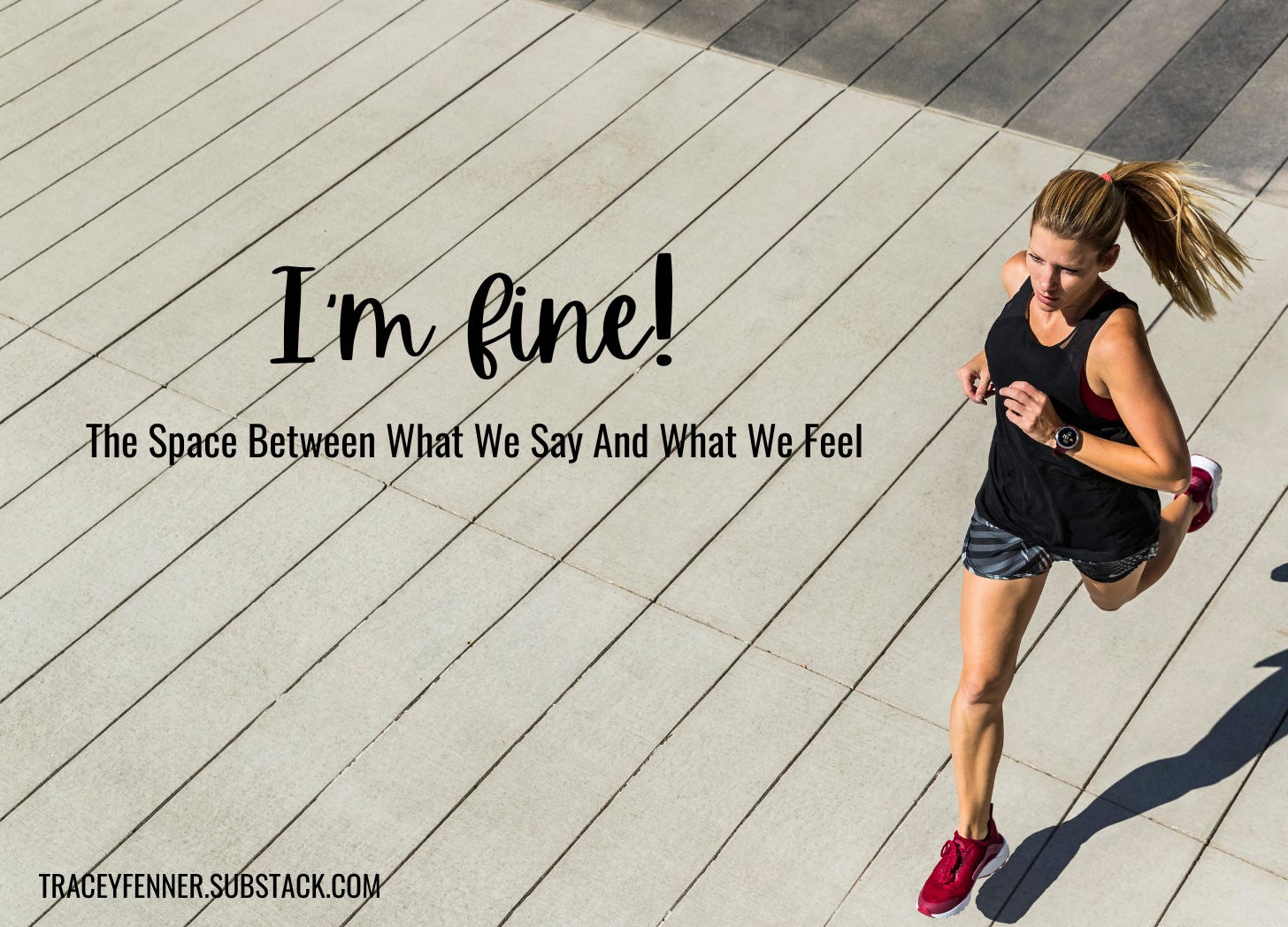
‘I’m fine’ - these words landed lightly, almost convincingly, but beneath them was a quieter truth, one that didn’t fit as neatly into conversation and so remained unsaid. When you are juggling too many things, running slightly late, and wondering why everything feels just a little bit harder than it should. I don’t think I’m alone in my thinking that these two little words are one of the most well-rehearsed phrases we have. Quick. Automatic and socially acceptable.
It slips out without pause, whether at the school gate, in meetings, on calls with friends, it’s the quiet habit of hiding what’s really there. . .
How are you? ‘I’m fine.’
And then often the conversation just moves on, but lately I’ve been paying closer attention to those two words, because ‘I’m fine’ is rarely about truth, instead I think it’s more about containment.
When we say ‘I’m fine’ it keeps things moving and it avoids awkwardness and helps to protect the moment. In a sense it signals: nothing to see here, but underneath, there is often something else, and maybe that’s
Fatigue?
Overwhelm?
Irritation?
A quiet undercurrent of something that’s not quite resolved, it may not be over dramatic, but still present and over time, ‘I’m fine’ becomes less of a response and more of a habit of not checking in at all, like a polite mask.
There’s something about midlife that makes ‘I’m fine’ harder to say convincingly, not because life suddenly falls apart but because your body starts telling the truth more clearly. You start to notice what you used to override, the tiredness that lingers, the tension that doesn’t quite leave you and the sense that you’re holding more than you’re expressing. You say ‘I’m fine’ but your body quietly disagrees, and that’s where something begins to shift.
But what is ‘fine’ really doing?
‘I’m fine’ isn’t a lie in the usual sense, but I feel it’s a form of protection, as it protects you from having to explain something you don’t yet have words for. It protects you from feeling exposed and from slowing things down, and I also believe it helps to protect others too, as it keeps things light, more manageable and contained, but it also keeps something else contained - and that’s YOU.
I’ve been exploring a different kind of response. This isn’t about never saying ‘I’m fine,’ but it’s more about noticing it more.
I’ve been allowing it to become a pause point rather than a default, a small moment where I check in with myself before I respond, such as. . .
What is actually true for me right now?
Sometimes my answer is still be ‘I’m fine, ‘ but sometimes it feels softer, more real, such as. . .
‘I’m a bit tired today.’
‘I’ve got a lot on.’
‘I’m not quite sure, if I’m honest.’
Nothing that dramatic, but just closer to my truth of how I’m actually feeling in that moment.
But here’s the part we don’t often talk about - ‘I’m fine’ isn’t just something we say to other people, it’s something we say to ourselves, quietly and repeatedly, almost unconsciously.
When your body feels tight — I’m fine.
When you’re running on empty — I’m fine.
When something feels off — I’m fine.
And this is where I believe it matters the most, because your body is always listening. Not to what you perform, but to the quiet, internal narrative you have on repeat.
If the message is always ‘I’m fine,’ even when you’re not, the body learns to keep going (and not because it’s thriving) but because it hasn’t been given permission to do anything else.
How does this land for you?
. . .because it hasn’t been given permission to do anything else?
What if the shift isn’t about what you say out loud. . . but what you’re willing to admit internally?
Not: ’I’m fine.’
But reframing it as: ‘Something here needs my attention.’
Not: ’I’m fine.’
But reframing it as: ‘I’m more tired than I realised.’
Not: ’I’m fine.’
But reframing it as: ‘I think I’ve been carrying a lot.’
These are not dramatic statements, but I’d say they are more honest ones, and honesty is where self-regulation begins.

So with this in mind as we ‘move inwards’ today my invitation to you is to start to notice the next time you catch yourself saying ‘I’m fine,’ whether that’s out loud to someone else or internally to yourself (slightly harder!)
When you notice yourself saying these two little words, try to PAUSE and take one or two deep breaths.
And ask yourself instead:
If I wasn’t saying ‘I’m fine’. . . what would I say instead?
Then you don’t have to share what you have noticed here, just let yourself hear your words, because sometimes the most powerful shift isn’t changing what the world hears. . . it’s changing what you’re finally willing to hear from yourself. That moment before truth has a voice.
Remember the hardest part is continuing to show up for yourself with all the things you have to do and accomplish today.
Thank you for continuing to show up here. It’s an absolute pleasure to share this time with you.
❤️ Namaste Tracey Xx
Please feel free to share You Are Not Alone with loved ones and friends. I trust whoever needs to read my musings will find them as a source of inspiration and hope. They are all written from my heart and offer the opportunity to dive deeper into truth, authenticity and trust.

Moving Inward = Self-care exercises designed to devote time to turning your gaze inwards and spend some precious ‘me time’ as often as possible. This helps to cultivate a beautiful conscious conversation with your body, mind & emotions. Through this process we get to practise listening, to be who we are, and creatively explore who we want to be. I hope the audios that I create with each essay helps you with this ❤️ how we move matters - where attention goes energy flows.

Yes, "I'm fine" has become an automatic response in our culture. I have no problem using it in brief surface encounters with people I see in passing. It protects all of us from awkwardness and keeps the day moving. But I wholeheartedly agree with you about sharing a bit more honesty in our actual circles. Thanks for your always wise words.
Thank you for restacking Jane 🙏